Commercial real estate is about more than finding a property. Whether you want to lease, buy, sell, or invest. A local GTA commercial real estate agent can help you understand your options. With local market knowledge and clear advice, you can move forward with confidence.
Why Local GTA Commercial Real Estate Expertise Matters
A local GTA agent helps you look at the market, compare properties, talk through terms, and lower your risk. This is true whether you are renting, buying, selling, or investing in Toronto and the cities around it.
Understanding the Complexity of the GTA Commercial Market
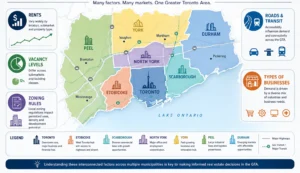
The GTA commercial market is not one simple place. Each area has its own rents, vacancy levels, zoning rules, roads and transit, and the types of businesses that want to be there. The GTA includes Toronto, Mississauga, Brampton, Vaughan, Markham, Scarborough, North York, Etobicoke, and communities in Peel, York, Durham, and Halton. Each of these places works differently. What a property costs in one city may be very different from what it costs in another city nearby. You also have different types of properties to think about. Industrial buildings, office spaces, retail stores, mixed-use buildings, and development land all work differently and attract different buyers and renters.
A good local agent knows these differences. That knowledge helps you pick the right property in the right place at the right price.
How Commercial Real Estate Agents Support Business Growth
A commercial real estate agent in GTA helps your business grow by matching the right space, the right location, the right cost, and the right lease terms to what your business needs. Maybe your business is getting bigger and you need more room. Maybe you want to move to a new location. Or maybe you want to cut costs by moving to a smaller or cheaper space. An agent can help with all of these.
Here are some examples of how different businesses think about space:
- A logistics company may want easy access to major highways and a building with high ceilings for storing goods.
- A medical office may want plenty of parking, easy access for patients with mobility needs, and zoning that allows health services.
- A retail store may want a busy street with good signage and lots of foot traffic. Your agent should understand your business first and then find space that fits.
Navigating Commercial Property Opportunities Across the GTA
A GTA commercial agent helps you find both listed properties and off-market opportunities. Off-market means the property is not advertised to the public but is still available if you know the right people. Your agent will use their network of landlord contacts and other brokers to find options you might not find on your own. They will help you compare those options, plan property tours, and build a strong offer strategy. This matters because the GTA commercial market moves fast. Having the right agent on your side means you get to see good properties faster and you are ready to act when the right one comes along.
Commercial Property Types in the Greater Toronto Area
Knowing what type of commercial property fits your needs is the first step in your search.
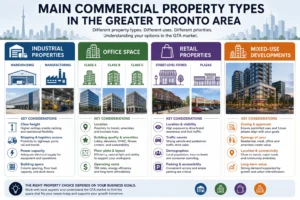
Industrial Properties and Logistics Facilities
Industrial properties are used for warehousing, manufacturing, shipping, e-commerce, and logistics. They are common in Mississauga, Brampton, Vaughan, and Scarborough.
When looking at an industrial property, these features matter a lot:
- Clear height is how tall the inside of the building is. Taller ceilings let you stack more goods.
- Loading doors and dock access make it easier to bring trucks in and out.
- Yard space gives trucks room to turn and park.
- Power supply matters for manufacturing and some warehouse operations.
- Zoning tells you what activities are allowed in the building.
Current rent and vacancy data should be reviewed from market reports before making a decision.
Office Space Leasing and Investment Opportunities
Office space is used by professional services firms, tech companies, medical users, and corporate teams.
Office space comes in three main grades. Class A is newer, well-located, and has more features. Class B is older but still functional. Class C is basic and lower cost.
When choosing office space, think about these things:
- Where is the office located? Is it downtown, in a suburb, or near a transit stop?
- What is the layout like? Does it work for your team?
- How long is the lease? Can you grow into more space if you need to?
- What will it cost to build out the space? Will the landlord help pay for improvements?
- How is the parking? Is there transit nearby?
Hybrid work has changed how businesses use office space. Your agent can help you think through how much space you really need.
Retail Properties and Mixed-Use Developments
Retail properties connect businesses with their customers. They include street-level stores, plazas, power centres, restaurants, and service businesses.
When choosing retail space, think about traffic counts, how visible the location is from the street, signage options, parking, and what other businesses are nearby.
Mixed-use developments combine residential units, office space, and retail stores all in one building. These can be a good fit for businesses that want to be near where people live.
Permitted use is important in retail. This means your lease and the local zoning must allow the type of business you want to run. Exclusivity clauses can also protect you from direct competitors moving into the same plaza.
Specialized Commercial Assets and Alternative Investments
Some commercial properties need extra attention before you buy or rent them. These include medical offices, automotive properties, self-storage facilities, hotels, data centres, and raw land.
These properties often have special rules. You may need operating permits. There may be environmental concerns. Zoning may be strict. And the pool of buyers or renters may be smaller.
If you are looking at a specialized property, get help from specialists in environmental review, legal matters, engineering, and financing. An experienced agent will know when to bring in those experts.
Commercial Real Estate Services for Tenants and Occupiers
If you are renting commercial space, a tenant representative is on your side. They do not work for the landlord.
Tenant Representation and Lease Negotiation
Tenant representation means an agent who protects your interests during the search, negotiation, renewal, expansion, or move to a new space. A tenant agent helps you with the lease term, the rent amount, free rent and other landlord offers, renewal rights, assignment rights, and exit options.
They also look at the fine print, including operating costs, maintenance rules, and what you have to fix or restore when you leave. Always have a lawyer review your lease before you sign.
Site Selection and Market Analysis
Site selection means comparing different locations, properties, costs, and market conditions before you commit. Your agent will start by understanding your needs. Then they will compare locations based on what matters most to your business.
Here is a simple guide to what different businesses look for:
- Warehouse users want highway access, good loading, and high ceilings.
- Retail businesses want high visibility, strong traffic, and good signage.
- Office users want transit access, amenities, and parking.
- Medical businesses want accessibility, proper zoning, and patient parking.
For retail and service businesses, demographic data helps you understand who lives and shops nearby. For industrial users, logistics mapping helps you plan delivery routes.
Reducing Occupancy Costs and Improving Efficiency
A commercial agent helps you control costs by looking at all parts of your lease, not just the base rent. You should understand the difference between gross rent and net rent. With net rent, you also pay for property taxes, maintenance, and insurance. These are called TMI costs. Other costs to consider include utilities and build-out expenses.
Your agent can help you right-size your space, look at sublease options if you have too much space, and plan your renewal or relocation in advance to keep costs down. Inefficient space is expensive. If your space is too big, you are paying for empty areas. If it is too small, your team cannot work well.
Commercial Real Estate Services for Property Owners
If you own commercial property, the right agent helps you attract tenants, sell at the right price, and improve how well your property performs.
Commercial Leasing and Marketing Strategies
A good leasing strategy attracts qualified tenants, reduces vacancy time, and improves your lease terms.
Your agent will position your property well by setting the right asking rent based on market data, creating strong listing materials, reaching out to brokers, and running tours with interested tenants.
For vacant or underused space, an agent can build a plan to fill it faster and with the right type of tenant.
Asset Management and Property Performance Optimization
Asset management means looking after your property so it earns more income over time. This includes keeping tenants happy so they stay, planning for lease renewals before they expire, reviewing operating expenses, and planning capital improvements before small problems become big ones. Net operating income or NOI is the income your property earns after expenses. Improving NOI improves the value of your property.
If a property is not performing well, your agent can help you think about repositioning it to attract different tenants or change its use.
Property Valuation and Advisory Services
Understanding what your property is worth helps you make better decisions about selling, refinancing, or holding. Valuation looks at the income your property earns, what similar properties have sold for, what it would cost to replace the building, and current market conditions. Key factors include NOI, cap rate, lease terms, tenant quality, and the condition of the building.
Note that a formal appraisal for financing or legal purposes must be done by a qualified appraiser. An agent can help you understand value in the context of your goals but is not a replacement for a certified appraiser.
Commercial Real Estate Investment Services
If you are buying or selling commercial property as an investment, you need an agent who understands income, risk, and long-term value.
Investment Analysis and Acquisition Strategy
Before you buy, you need to understand how the property will perform financially.
Key terms to know:
- NOI is the income after expenses.
- Cap rate is the rate of return you get based on the purchase price and NOI. A lower cap rate usually means a more stable property in a strong location.
- Cash flow is what is left after you pay your mortgage and expenses.
- Lease rollover is the risk that leases expire and tenants leave.
Vacancy allowance is a buffer you build into your projections because no property is always fully occupied.
Different investors have different goals. Some want steady income. Some want to improve a property and sell it. Some want to redevelop land. Your agent should understand your goal before recommending a property.
A sample acquisition checklist to review:
- Review the income and expenses.
- Review all leases.
- Inspect the building systems.
- Confirm the zoning.
- Assess any environmental risk.
- Review the title and surveys.
- Test your financing assumptions.
Commercial Property Due Diligence
Due diligence is the process of checking everything about a property before your purchase becomes final. You should review leases and the rent roll, operating expenses, title, surveys, zoning, environmental reports, and the condition of the building. Tenant estoppels confirm that tenants agree with the lease terms on record. Service contracts tell you what agreements you are taking on when you buy.
Your lender will also have due diligence requirements. A lawyer should be involved throughout this process. Due diligence timelines must match how complex the property is. A simple single-tenant property needs less time than a large multi-tenant building.
Commercial Property Disposition and Exit Planning
Selling a commercial property works best when you plan ahead. Start by understanding the value, the timing in the market, who your likely buyers are, and what they will want to see. Buyers may include owner-users who want to run their business in the building, investors looking for income, developers looking to build something new, or institutional buyers looking for large assets.
A strong marketing package, clear documentation, and pre-sale due diligence reduce buyer concerns and support a better price. For complex properties, a staged marketing approach may work better than a wide public listing right away.
GTA Commercial Real Estate Markets and Sub-Markets
The GTA is made up of many different areas. Each one works differently.
Mississauga and Brampton Industrial Markets
Mississauga and Brampton are two of the most active industrial markets in Canada. Mississauga commercial real estate market is great for investment. Businesses choose these cities because they are close to major highways, near Pearson International Airport, and have a large pool of workers.
These cities support warehousing, distribution, e-commerce, manufacturing, and logistics operations.
When choosing an industrial site in these areas, think about loading capacity, yard space, and whether the zoning matches your business activity.
Current availability and rent data should come from verified market reports before you make a decision.
Downtown Toronto Office and Mixed-Use Markets
Downtown Toronto is home to a mix of office, retail, institutional, and mixed-use properties. The financial district, professional services, technology companies, education institutions, and healthcare users are all active here. Transit access is a key advantage in downtown Toronto. Many employees and clients can reach the area by subway, streetcar, or bus without needing to drive.
Office class, amenities, and adaptive reuse of older buildings are all important factors to review. Current downtown market data should be reviewed from a verified source before making any decisions.
North York and Etobicoke Commercial Corridors
North York and Etobicoke offer a mix of office space, industrial pockets, retail plazas, and areas that are being redeveloped. These corridors sit between downtown Toronto and the suburbs. Businesses here get access to highways and transit without paying downtown prices. If your business needs to be near Toronto but does not need to be in the core, North York and Etobicoke are worth looking at.
Emerging Opportunities Across the Greater Golden Horseshoe
Beyond the GTA, the Greater Golden Horseshoe includes Hamilton, Burlington, Oakville, Milton, Oshawa, Pickering, Ajax, Whitby, Newmarket, and Barrie. Population growth, new infrastructure, and business migration from the GTA are creating opportunities in these areas for industrial, logistics, land, and mixed-use development.
Be careful though. Opportunities in these areas depend on zoning, servicing, transportation, and approval timelines. Research is essential before committing to anything outside the core GTA.
Zoning, Land Development, and Commercial Property Compliance
Zoning rules control what you can do with a commercial property. Understanding zoning before you sign anything is critical.
Development Land Sales and Advisory Services
Development land is raw or underused land that could be built on or repurposed. Land value depends on what you are allowed to build, how much you can build, whether the land has services like water, sewer, and roads, and how long approvals will take.
Types of development land include infill sites in built-up areas, land assemblies that combine multiple parcels, employment land for industrial or office use, and mixed-use intensification sites. Your agent should help you understand the planning process and connect you with planning and legal experts when needed.
Zoning, Municipal Regulations, and Due Diligence
Zoning by-laws tell you what a property can be used for. They also control parking requirements, setbacks from the street and neighbouring properties, loading, signage, and building density. Before you commit to a property, confirm that your intended use is allowed. If the zoning does not fit what you need, you may need a minor variance or a rezoning application. Both take time and money.
Site plan control is another approval process that applies to many commercial properties in Ontario. A lawyer and a planner should be involved for any complex use or development.
Commercial Development Opportunities in Ontario
New commercial development depends on land supply, municipal approvals, servicing capacity, construction costs, financing, and tenant or buyer demand.
Active development types in Ontario include new industrial buildings, mixed-use intensification projects, retail redevelopment, and adaptive reuse of older buildings.
Planning timelines in Ontario can be long. Always get current policy and infrastructure information from a planner or municipal source before starting a development project.
Choosing the Right GTA Commercial Real Estate Agent
Not every commercial agent is the right fit for your needs. Here is how to find a good one.
Evaluating Local Market Knowledge and Industry Experience
The right agent understands your specific asset type, your location, and how your transaction works. Ask them about recent deals they have done in your area and with your type of property. Ask about the clients they work with and the strategies they use.
Experience with the right property type matters more than just being based in the GTA.
Brokerage Network, Resources, and Market Reach
A strong network gives you access to more listings, more buyers, more tenants, and more market data. Your agent should have relationships with landlords, other brokers, investors, and property managers. That network is what gives you access to off-market deals and faster results.
Ask about the databases and marketing tools the agent uses and how they reach potential buyers or tenants.
Trust, Transparency, and Professional Representation
A trustworthy agent communicates clearly, discloses any conflicts of interest, gives you documented advice, and negotiates with your interests in mind. They should keep your information private, explain their role and duties, and give you regular updates backed by market evidence.
Avoid agents who make promises they cannot support with data.
Questions to Ask During Your Initial Consultation
Here are good questions to ask any commercial real estate agent before you hire them:
- Which GTA sub-markets do you specialize in?
- Which commercial property types do you handle most often?
- How do you find off-market opportunities?
- How do you compare lease or purchase options?
- What due diligence risks should I expect?
- How do you negotiate lease terms or sale conditions?
- Which market data will you use to guide your advice?
- How will you keep me updated during the process?
GTA Commercial Real Estate Agent Services for Long-Term Success
A good commercial agent does more than close one deal. They help you make better decisions over time.
How the Right Commercial Agent Creates Value
The right agent improves your market access, lowers your risk, and helps you get better results in lease and purchase negotiations. Over time, they can help you with renewals, relocations, new acquisitions, property sales, portfolio reviews, and long-term planning.
Smart advice about timing, cost control, and opportunity selection builds real value for your business or investment portfolio.
Start Your Commercial Real Estate Journey in the GTA
Start by being clear about what you need. Think about your property type, the size of the space, your preferred location, your budget, and your timeline. Whether you are a tenant looking for space, a business owner buying a building, an investor looking for income, or a developer looking for land, a GTA agent can help you move forward with clear local market guidance.
Speak with a GTA real estate agent today to compare your leasing, buying, selling, or investment options.